
Determinant
1. What is a determinant and what properties does it have?
Solution:
The determinant of order n is a number D, created from n2 numbers aik, arranged into a square table with n rows and n columns of the form
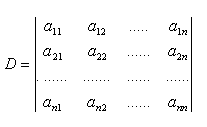
a11,a12,...a1n => row of the determinant
a11,a21,...an1 => column of the determinant
a11,a22,...ann => main diagonal
Value of the determinant:
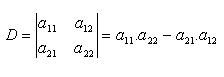
- Second-order determinant
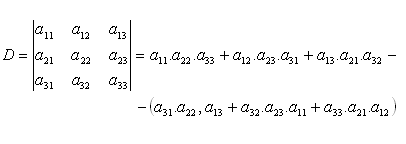
- Third-order determinant (Sarrus' rule)
Determinant of degree n:
A determinant of degree n has n rows and n columns (n > 3). The subdeterminant (minor) Mij corresponding to the element aij is obtained from determinant D by removing the i-th row and j-th column.
Algebraic complement (cofactor):
Aij = (-1)i+j · aij · Mij
Expansion of a determinant:
a.) along the i-th row:
D = ai1Mi1 + ai2Mi2 + ... + ainMin
b.) along the j-th column:
D = a1jM1j + a2jM2j + ... + anjMnj
2. State the theorems about the value of a determinant.
Solution:
- 1) The value of the determinant does not change if we swap its rows with its columns (i.e., transpose).
- 2) The value of the determinant does not change if we add (or subtract) any multiple of another row to a given row.
- 3) The value of the determinant equals zero if all elements in some row are zero.
- 4) The value of the determinant equals zero if some row is a scalar multiple of another row.
- 5) The value of the determinant equals zero if two rows are identical.
- 6) The determinant changes sign if we interchange two rows of the determinant.
- 7) We can factor out a number “c” from the determinant that multiplies some row.
- 8) Multiplying the determinant by a number “c” means multiplying one of its rows by that number (only a single row). c <> 0
Note:
The stated properties also apply to the columns of the determinant.
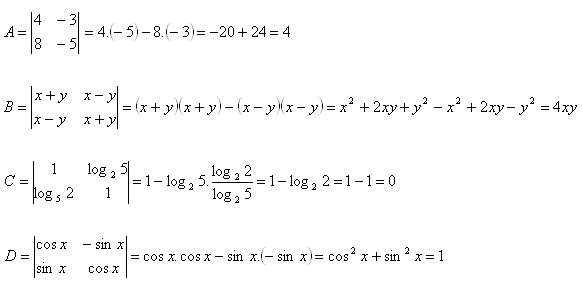
3. Compute the determinants:

Solution:
4. Compute the determinants:
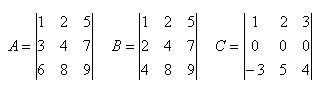
5. Compute the determinants:
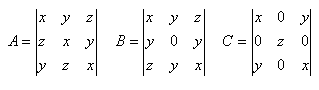
6. Solve the equations in R:
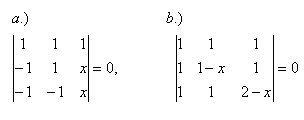
7. Solve the equations in R:
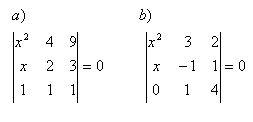
8. Calculate the area of triangle ABC with vertices:
9. Calculate the area of triangle ABC whose sides have equations:
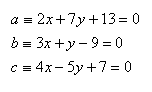
10. Determine whether points A, B, C lie on one line, if:
11. Determine whether points A, B, C lie on one line, if:
12. Given points A, B, C. Find the first coordinate of point B so that A, B, C lie on the same line. Given:
13. Write the equation of the line that passes through points A and B if:
14. Write the equations of the sides of triangle ABC with vertices
15. Compute the vector cross product of two vectors:
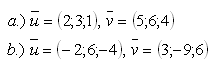
16. Solve the systems of linear equations:
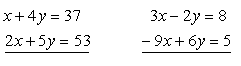
17. Solve the system of linear equations:
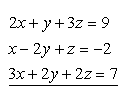
18. Solve the system of linear equations:
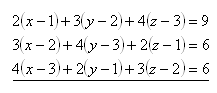
19. For the given determinant D determine the algebraic complement A23
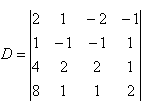
20. Compute the determinant:
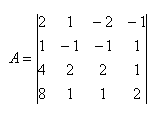
21. Compute the determinant:
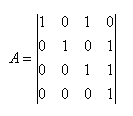
22. Determine whether points A, B, C, D lie in the same plane if:
23. Write the general equation of the plane given by points A, B, C if:
24. Write the general equation of the plane passing through points A, B, C if
25. Solve the system of equations:
x + y + z + u = 10
x + y – z – u = 4
x – y + z – u = 2
x – y – z + u = 0
```
