
Dispersion and polarization of light
1. Explain the dispersion and polarization of light.
Solution:
Decomposition of Light
White light is a mixture of seven monochromatic colors (red, orange, yellow, green, blue, indigo, violet), i.e., a mixture of electromagnetic waves with different frequencies.
| R | O | Y | G | B | I | V |
|---|---|---|---|---|---|---|
| f (10¹⁴ Hz) | 4.6 | 5.0 | 5.2 | 5.75 | 6.7 | 7.0 |
Individual colored lights propagate in a medium at different speeds ,
therefore they have different refractive indices and refract at different angles.
Polarization of Light
Natural light is unpolarized. It is a transverse electromagnetic wave, characterized by oscillations of mutually perpendicular vectors
. On the retina of the eye, only the oscillations of the vector of electric field intensity act.
In polarized light, the oscillation of vector occurs in one plane.
Complete polarization occurs when the angle of incidence is the so-called Brewster’s angle .
At the polarization angle , the reflected ray is perpendicular to the refracted ray.
2.The wavelength of the hydrogen line H2 in air is λ0 = 656.4nm. What is its wavelength in water? (n = 1.33)
Solution:
Analysis:
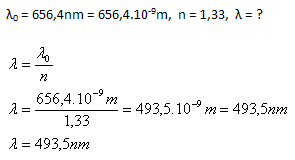
The wavelength of the hydrogen line H2 in water is λ = 493.5nm.
3. Determine whether the speed at which light propagates depends on its frequency
b) in a medium,
Solution:
a) In vacuum:
b) In a medium:
In vacuum, the speed of light does not depend on frequency, in a medium it does.
4. Derive the formula for calculating Brewster's angle – the angle of complete polarization.
Please log in to view the solution.5. The angle of complete polarization for opaque enamel is αp = 58°. What is the refractive index of the enamel? (n1=1,n2=?)
Please log in to view the solution.
6. Calculate Brewster's angle of complete polarization for:
- water: n = 1.33
- glass: n = 1.5
- diamond: n = 2.465
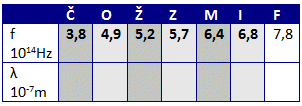
7.Complete the table of light dispersion:
| R | O | Y | G | B | I | V |
|---|
8.A light ray falls from air onto the water surface at an angle of incidence α = 70o. Determine which of the colored rays (red or violet) deviates the least or the most from the original direction of the light ray before striking the water.
Please log in to view the solution.9.A diamond plate (n = 2.465) is illuminated with the violet component of light (f = 7.8·1014 Hz). Determine the wavelength of the violet component of light in vacuum and in the diamond.
Please log in to view the solution.10.The angle of complete polarization for diamond is αP = 68o. What is the refractive index of diamond? At what angle does a monochromatic light ray refract if its angle of incidence is the angle of complete polarization?
Please log in to view the solution.11.At what angle of incidence does complete polarization occur when light is reflected at the interface of ice (n1 = 1.308) and water (n2 = 1.333)?
Please log in to view the solution.
