
Electric field
1.Characterize electric charge, Coulomb's law, and electric field.
Solution:
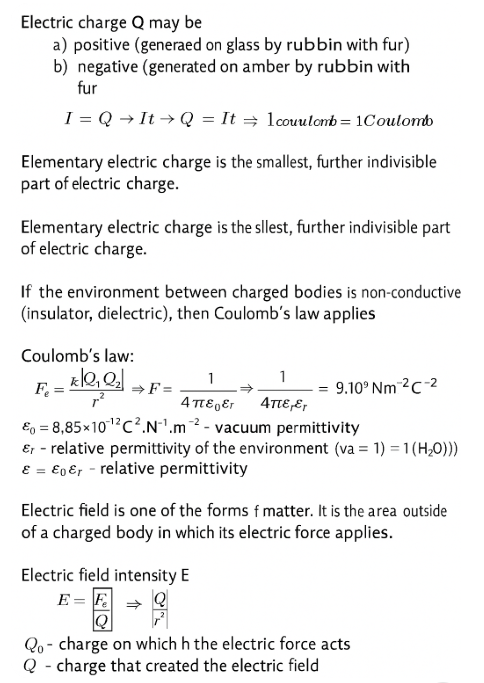
Electric charge Q is a scalar physical quantity that characterizes the property of bodies (particles) to engage in electromagnetic interaction.
2.An electric charge of 80 nC was generated on a glass rod rubbed with leather. How many electrons moved from the rod to the leather? How did the mass of the glass rod decrease in this process?
Solution:
Analysis:
Q = 80 nC = 80.10-9C, e = 1.602.10-19C, me = 9.1.10-31kg, n = ? Δm = ?
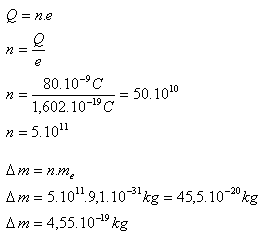
5.1011 electrons moved to the leather. The mass loss of 4.55.10-19kg is not measurable.
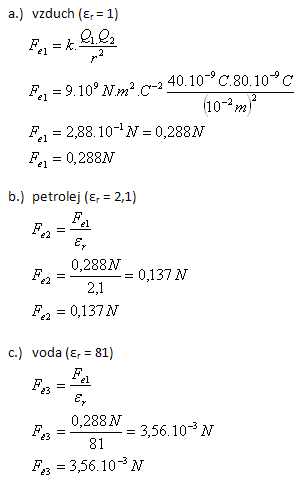
3. Two small spheres, one with charge Q1 = 40 nC, the other Q2 = 80 nC, are placed next to each other at a distance of 1 cm. What are the magnitudes of the forces acting on each other if they are:
a.) in air (εr = 1)
b.) in kerosene (εr = 2.1)
c.) in water (εr = 81) k = 9.109N.m2.C-2
Solution:
Analysis:
Q1 = 40.10-9C, Q2 = 80.10-9C, r = 10-2m, k = 9.109N.m2.C-2
4.Two identical charges Q1 = Q2 = 5.10-8C repel each other in air (k = 9.109N.m2C-2) with a force of 2.5.10-4N. What is the distance between them?
Please log in to view the solution.
5.Between two positive point charges Q1 and Q2 at a distance r1, a force Fe1 acts in a medium with εr1. If both charges are moved to a medium with εr2 and the distance r2 is adjusted so that the magnitude of the force remains the same, determine the ratio r1 : r2!
Please log in to view the solution.
6.Two positive point charges Q1 and Q2 = 4.Q1 are fixed at two points 6 cm apart. Determine where a third charge Q0 should be placed on the line connecting the two points so that it experiences no electric force.
Please log in to view the solution.
7.What is the magnitude of the electric force acting on a proton ( Qp= Q0 = 1.602×10⁻¹⁹C, mp = 1.672×10⁻²⁷kg) located in an electric field with an electric field intensity of 2×10⁵N.C-1? What will be the acceleration of the proton at that point in the electric field?
Please log in to view the solution.
8.At a certain point in the electric field of a positive point charge (in a vacuum), a force Fe = 10-4N acts on a charge Q0 = 50 nC. Determine
- a.) the electric field intensity at this point
- b.) the magnitude of the creating charge Q at a distance r = 0.3m from Q0
9. A small particle with a mass of 1 mg and a charge of 0.5 nC is initially at rest. With what acceleration will it move in a uniform electric field with an intensity of 30 kV.m-1? What distance will the particle travel in 0.1 s in a vacuum? Neglect gravitational force acting on the particle.
Please log in to view the solution.10. A small dust particle has a mass of 0.01 mg, a charge of 10 nC, and is placed in a uniform electric field. The field lines are horizontal. The particle starts moving from rest and reaches a speed of 50 m.s-1 in 4 s. Determine the electric field intensity!
11.Two tiny spheres with an electric charge of equal magnitude 2×10⁻⁸C attract each other in a vacuum. Determine this force if the charges are at a distance of 30 cm.
Please log in to view the solution.
12.Compare the electric and gravitational forces with which two electrons in a vacuum act on each other at a distance of 10 micrometres.
Please log in to view the solution.
13.Our Earth represents a negatively charged sphere with a surface charge density of 1.1·10–15 C·m–2. Calculate the electric charge of the Earth.
Please log in to view the solution.
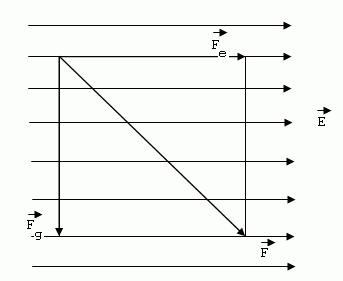
14.A small ball with mass 0.4 g and charge 5·10-7 C is suspended on a thread and placed in a homogeneous electric field whose field lines are horizontal. The electric force deflects the ball with the thread in the direction of the electric field lines. Determine the angle by which the thread deviates from the vertical direction. (Draw a sketch.)
Please log in to view the solution.
15.How must the distance between two positive point charges Q1 and Q2 in a vacuum be changed if charge Q1 increases fourfold and the Coulomb force remains unchanged?
Please log in to view the solution.
16.A point electric charge Q creates an electric field in a vacuum. A charge Q0 is acted upon by an electric force. The charges are placed into a dielectric. If we want the force acting on charge Q0 to remain the same as in a vacuum, we must move charge Q0 to half the distance. Determine the relative permittivity of the dielectric.
Please log in to view the solution.
17. Determine the number of protons corresponding to a charge of 10 coulombs.
Please log in to view the solution.
18.Two identical electric charges at a distance of 6 cm attract each other with a force of 5.6 N. Determine the magnitude of these charges in a vacuum.
Please log in to view the solution.
19.Two identical charges Q1 = Q2 = 10–6 C repel each other with a force of 4 N in a vacuum. By how much must the distance between the charges be changed so that they repel with the same force in kerosene?
Please log in to view the solution.
