
Optical instruments
1. Which optical instruments do you know?
Solution:
Optical instruments are devices used for observing small or distant objects.
They increase the visual angle of an object. This is the angle of the rays that pass through the edge points of the object and enter the eye.
Among optical instruments belong:
a) the eye,
b) magnifying glass,
c) microscope,
d) telescope,
e) camera, video camera, projector, etc.
The eye is a converging (compound) optical system. It creates on the retina (the yellow spot) a real, reduced and inverted image.
Near point:
Conventional viewing distance:
Normal eye:
Eye with glasses:
– optical power, ,
– distance of the object from the eye,
– distance between the image (on the yellow spot) and the eye lens.
A magnifying glass is any converging lens for which .
Angular magnification of a magnifying glass:
A microscope is an optical instrument used to increase the visual angle when observing very small objects. Its main parts are the objective and the eyepiece. The objective () and the eyepiece () are converging lenses. is the optical tube length (interval) of the microscope. is the distance between the objective and the eyepiece. It holds that
Angular magnification of a microscope:
A telescope (Keplerian, Galilean) is an optical instrument for increasing the visual angle when observing distant objects. The objective () and the eyepiece () are converging lenses.
Angular magnification of a telescope:
2. Under what visual angle do we observe from Earth the Moon (RM=1738 km, lM=384 493km ) and the Sun (RS=695 980 km, lS=149 597 892 km )? τ = the visual angle under which we observe the radius of the Moon or the radius of the Sun.
Solution:
- Mesiac = Moon
- Slnko = Sun
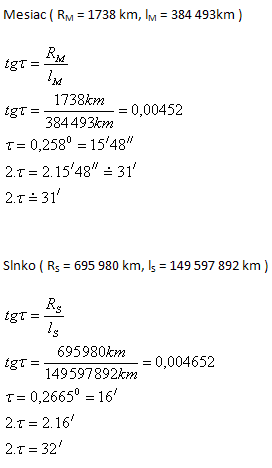
We observe the Moon under an angle of 31‘, and the Sun under an angle of 32‘.
3. Up to what distance can the human eye distinguish two points that are 1m apart?
Solution:
Analysis:
y = 1m, the eye can distinguish two points if τ is at least 1‘, x = ?
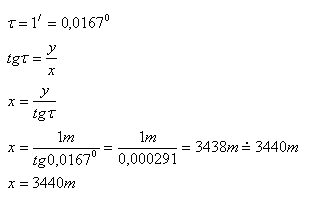
The human eye can distinguish two points up to a distance of x = 3440m
4. What is the maximum and minimum focal length of a lens that can be used as a magnifying glass? With a magnifying glass, angular magnification can be achieved.
Please log in to view the solution.
5. A farsighted eye has the nearest clear vision distance at 2m. What glasses are needed?
Please log in to view the solution.
6. Determine the magnification of a microscope with an objective focal length of 4mm, an eyepiece of 4cm, and an optical interval of 16cm.
Please log in to view the solution.
7. A microscope has magnification γ = 320 and an objective focal length of 5mm and an eyepiece of 2.5cm. Determine the distance between the objective and the eyepiece l and the tube length L.
Please log in to view the solution.
8. What lenses are needed to construct a Keplerian telescope if the objective and the eyepiece are 80cm apart and the telescope magnifies 19 times?
Please log in to view the solution.
9. The distance between the objective and the eyepiece of a Galilean telescope is 38cm. The magnification of the telescope is 20. Determine the focal length of the objective and the eyepiece.
Please log in to view the solution.
10. In a telescope with an objective focal length f1 = 100cm and an eyepiece f2 = 10cm we observe a tower 40m high. Its image in the telescope has a height of 4cm. How far away is the tower? (d = 25cm).
Please log in to view the solution.
11.A farsighted person can read a book sharply from a distance of 80 cm from the eyes. What optical power must the glasses have so that they see the text sharply from a distance of 25 cm?
12.Determine the height of the image formed on the retina of the eye (a/ = 2.28 cm), when looking at a tree 2 m high from a distance of 10 m.
Please log in to view the solution.13.When observing with a magnifying glass, the virtual image (Z > 0) was five times larger than the object placed 4 cm in front of the magnifying glass. What is the optical power of the magnifying glass and its angular magnification? The conventional distance is d = 25 cm.
Please log in to view the solution.14.From an airplane at an altitude of 1000 m, the Earth's surface is photographed using a camera whose lens focal length is 50 cm. What will be the scale of the photographs? How will this scale change when the airplane climbs to an altitude of 2000 m?
Please log in to view the solution.15.When focusing on the photographed object, it was necessary to move the lens 1 cm away from the film compared to the setting for infinity. At what distance from the camera lens ( f = 20 cm ) was the photographed object located?
Please log in to view the solution.16.A microscope with a 7× eyepiece has a total magnification of γ = 140. What magnification will the microscope have if we replace the eyepiece with another one whose focal length is 1 cm?
Please log in to view the solution.17.Under a microscope, a red blood cell has a diameter of 4.5 mm. The microscope’s objective magnifies 100×, the eyepiece 6×. What is the actual diameter of the red blood cell?
Please log in to view the solution.18.What is the angular magnification of a microscope whose objective has a focal length of 5 mm and the eyepiece 30 mm, if the distance between the objective and the eyepiece is 18 cm?
Please log in to view the solution.19.An opera (theater) binocular is 12 cm long and should magnify 5×. What focal lengths must the eyepiece and the objective have? The objective is a converging lens, the eyepiece is a diverging lens.
Please log in to view the solution.20.A telescope has an objective with a focal length of 1.2 m and an eyepiece with a focal length of 4 cm. What is its magnification? Determine under what angle we would observe the Moon with this telescope.
Please log in to view the solution.