
The physical meaning of derivation
1. What is the physical meaning of the derivative?
Solution:
- The instantaneous velocity at time t0 is the first derivative of displacement with respect to time:
v(t0) = s‘(t0).
- The instantaneous acceleration at time t0 is the first derivative of velocity with respect to time:
a(t0) = v‘(t0)
Example:
Find the instantaneous velocity and instantaneous acceleration of a motion at time t, whose displacement is given by the relation: 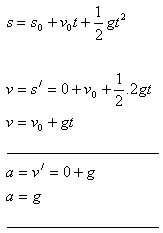
2.A stone thrown vertically upward from a height h = 10 m has initial velocity v0 = 20 m·s-1. What will be the stone's velocity at time t = 1.5 s? After what time will it reach its maximum height? What height will it reach? (g = 10 m·s-2)
Solution:
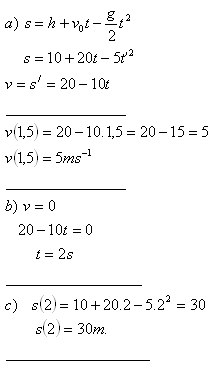
The stone's velocity at time t = 1.5 s is v = 5 m·s-1. It reaches the maximum height of 30 m after 2 seconds.
3.An object slides down an inclined plane 50 m long in 10 s. What is its final velocity, assuming that the displacement is a quadratic function of time and that the initial velocity is zero?
Solution:
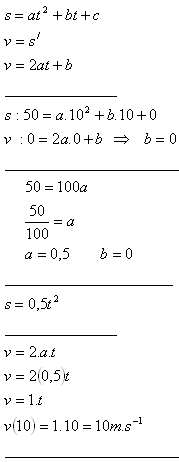
The final velocity of the object is v = 10 m·s-1.
4.A fast train traveling at 90 km·h-1 must brake uniformly so that it stops over a distance of 1 km. After what time will it stop?
5.Find how quickly altitude changes with air pressure.
The formula giving the altitude above Earth's surface as a function of air pressure. (p0 is the standard air pressure at sea level):

6.Determine the rate of change of vapor pressure (p) with respect to absolute temperature (T), if:

(C, L, R are constants)
7.The amount of electric charge Q passing through a conductor changes with time according to Q = 3t2 + 2t + 2. ([Q] = C, [t] = s)
8.In an inductive coil the current is i = 15·sin5(3t), [i] = A, [t] = s, [L] = 0.03 H. Calculate the induced electromotive force at time t = 2π/9 s according to the formula:

9.An object moves along a line and its displacement from equilibrium is given by: y = 2cos2πt - 3sin2πt. Find its velocity at time t = 1 s and the maximum displacement from equilibrium. (y is in cm)
Please log in to view the solution.
10.The power of a battery with electromotive force E and internal resistance Ri is: P = E·I – Ri·I2. At what current does the battery deliver maximum power? Determine that power.
Please log in to view the solution.
11.For the displacement of harmonic motion s = A·sin(ω·t). Derive the formulas for the velocity and acceleration of harmonic motion.
Please log in to view the solution.
12.The relationship between amount and mass in some chemical reactions is given by
x = A·(1 – e–kt). (A, k are constants).
13.A flywheel is rotating, is slowed down, and its motion is described by the equation
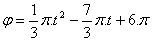
Write the equation for the angular velocity and determine after what time the motion becomes uniform rotation with angular velocity ω = π.
14.The piston moves back and forth according to s = –1.5 t3 + 9 t2 (cm). Calculate the maximum distance the piston reaches in 4 seconds. Also determine the velocities v0, v1, ... v6.
Please log in to view the solution.
15.For a moving body the displacement is given by s = t2 + 3t – 5 (m) and at time t = 0 its velocity was zero. Determine the displacement, velocity and acceleration at time t = 5 s. Also determine its kinetic energy if its mass is 8 kg.
Please log in to view the solution.
16.An object moves along the path s = t2 – t3/3 + 3t + 8 (m). Calculate
- a.) after what time it stops
- b.) what its acceleration will be at time t = 0.5 s
- c.) what distance the object travels until it stops
17.The amount of electric charge passing through a conductor changes according to Q = 2·t·e–t. Find the time when the current intensity will be zero.
Please log in to view the solution.
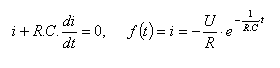
18.Verify that the given function describing the current of a discharging capacitor satisfies the differential equation:
Please log in to view the solution.
