
Substance characteristics
1.Which physical quantities characterize a substance?
Solution:
Atom AZX
-
– proton number (number of protons in the nucleus, number of electrons in the shell, the order of the element in the Mendeleev table)
-
– nucleon number (number of protons and neutrons in the nucleus)
-
– number of neutrons in the nucleus
Relative atomic mass
Relative molecular mass
Amount of substance – characterizes a substance based on the number of particles in it
1 mol – the unit of the amount of substance. One mole is also the amount of substance that contains as many particles as there are atoms in of .
Avogadro’s number:
Molar mass:
Molar volume:
2.Determine the rest masses of atoms of the elements H, C, Zn. What is the relative mass of Uranium if its rest mass is ma(U) = 3.95·10-25 kg. Use the tables.
Solution:
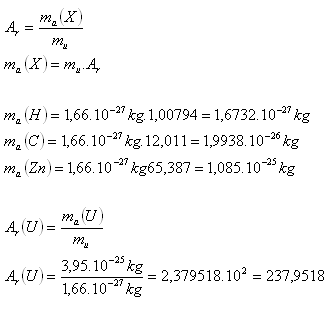
The relative mass of Uranium is approximately Ar(U) = 238
3.Estimate the approximate number of atoms contained in an iron weight with mass 1 kg. How long would a line be if all these atoms were arranged tightly next to each other in a single straight line? The diameter of an atom is about 10-10 m.
Solution:
Analysis:
m = 1 kg, d = 10-10 m, mu = 1.66·10-27 kg, Ar(Fe) = 55.847
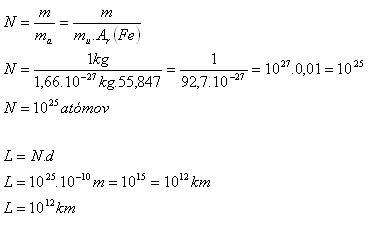
In one kilogram of iron there are 1025 atoms. The length of the line formed by these atoms would be 1012 km. This is about 6600 times greater than the distance Earth – Sun.
4. Determine the number of electrons contained in 1 g of copper. What is their total mass if the mass of a single electron is 9.1·10-31 kg?
Please log in to view the solution.5.Find out whether a molecule of nitric acid HNO3 has a greater mass than a molecule of silver oxide Ag2O. Use tables.
Please log in to view the solution.
6.Calculate the amount of substance corresponding to 4.82·1024 hydrogen atoms.
Please log in to view the solution.
7.Determine the amount of substance of water with volume 3.6 L.
Please log in to view the solution.8.Find out whether water with amount of substance 1 mol can be poured into a cylinder with volume 10 cm3.
Please log in to view the solution.
9. A room has dimensions a = 4 m, b = 4 m, c = 3 m. How many molecules of air are in it? (Mm = 29·10-3 kg·mol-1, ρ = 1.276 kg·m-3)
Please log in to view the solution.
10. From the surface of a water droplet with volume 1 mm3, water containing about 106 molecules evaporates in 1 second. In what time will the entire droplet evaporate?
Please log in to view the solution.11. Determine the relative molecular mass of carbon dioxide CO2 and the rest mass of the CO2 molecule. Use tables. (mu = 1.6605·10-27 kg)
Please log in to view the solution.
12. A closed container placed in a vacuum contains gaseous carbon dioxide with a mass of 1.1 kg. On average, N‘ = 1.5·1020 molecules escape from the container every second. After what time will all CO2 molecules escape from the container?
Please log in to view the solution.
13.Calculate the molar volume of lead.

14.The diameter of an oxygen molecule O2 is 0.364 nm. How long would the line be if all molecules contained in one mole of oxygen were arranged tightly next to each other?

15. A container with a volume of 2 liters contains 2.74·1019 molecules of chlorine Cl2. Calculate the molecular density NV of this gas.
16.Calculate the root-mean-square speed vk of a chlorine molecule Cl2 at a temperature of 100°C.
Please log in to view the solution.17.Calculate the average kinetic energy of one molecule of an ideal gas at a temperature t = –20°C. (k = 1.38·10-23 J·K-1)
Please log in to view the solution.18.Determine the diameter of a water molecule H2O.

19. A sample of oxygen O2 with a mass of 5 kg has a volume of 3.54 m3 at a temperature of 0°C and a pressure of 0.1 MPa. Determine the molar volume of oxygen.

20.Calculate how many molecules are contained in hydrogen H2 with an amount of substance n1 = 10 mol and in oleic acid C17H33COOH with the same amount of substance n2 = 10 mol.
Please log in to view the solution.