
Electric current in metals
1.When starting the electric rack railway train, a current of 500A is drawn from the line. Determine the total electric charge transferred by free electrons in 1 minute. How many electrons passed through the conductor? e = 1.602·10-19C.
Solution:
Analysis:
I = 500A, t = 60s, e = 1.602·10-19C Q = ?, n = ?
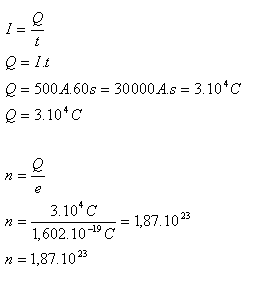
The total electric charge transferred by electrons is Q = 3·104C. 1.87·1023 electrons passed through the conductor.
2.The copper telegraph cable (ρ = 0.017·10-6Ω·m) between Snina and Humenné had a cross-section of 8mm2 and a resistance of 46.75Ω. What was its length?
Solution:
Analysis:
S = 8·10-6m2, R = 46.75 Ω, ρ = 0.017·10-6Ω·m, l = ?
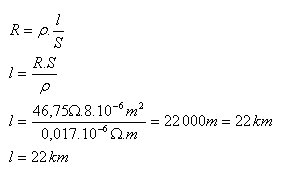
The cable was 22 km long.
3.A nickel wire (ρ1 = 0.4·10-6Ω·m) has a length l1 = 1.25m. What length should a constantan wire (ρ2 = 0.5·10-6Ω·m) of the same cross-section and the same ohmic resistance have?
Solution:
Analysis:
l1 = 1.25m, ρ1 = 0.4·10-6Ω·m, ρ2 = 0.5·10-6Ω·m, l2 = ?
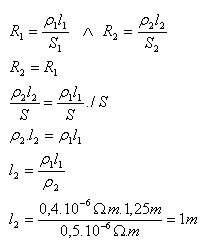
The length of the constantan wire would be l2 = 1m.
4.A platinum resistance thermometer (α = 3.9·10-3K-1) has a resistance of 500Ω at 20°C. The resistance of the thermometer in a heated furnace is 2500Ω. What is the temperature of the furnace?
Please log in to view the solution.
5.A copper wire (ρ1 = 0.02·10-6Ω·m) with a diameter d1 = 4mm needs to be replaced with an aluminum wire (ρ2 = 0.03·10-6Ω·m) of the same length. How thick should the aluminum wire be to keep the resistance unchanged?
Please log in to view the solution.
6.Two resistors R1, R2 in series have a total resistance of 5 Ω, and in parallel 1.2 Ω. What are the resistances of the individual resistors?
Please log in to view the solution.
7.A resistor with resistance R = 3.8 Ω is connected to an EMF source Ue = 12V. The current through the circuit is I = 3A. Determine the internal resistance, terminal voltage, and maximum current.
Please log in to view the solution.
8.A 15V EMF source with an internal resistance of 5 Ω is connected to a resistor with resistance 10 Ω. A capacitor with capacitance 1μF is connected in parallel to the source terminals. Determine the charge on the capacitor.
Please log in to view the solution.
9.A source of electromotive voltage 15 V with internal resistance 5 Ώ is connected to a resistor with resistance 10 Ώ. A capacitor with capacitance 1μ F is connected in parallel to the terminals of the voltage source. Determine the charge on the capacitor!
Please log in to view the solution.
10.Review your knowledge with a short test!
1.) The conventional direction of electric current in metals is the direction of motion of
a.) particles with positive electric charge
b.) particles with negative electric charge
c.) particles without charge
A.) a,b,c B.) a C.) b, c
2.) For Q, I, t it holds:
A.)
B.)
C.)
3.) An electric current I = 30 mA passed through a conductor and transferred a charge Q = 162 C. How long did the current flow through the conductor?
A.) 1 hour
B.) 1.5 hours
C.) 2 hours
4.) For V, A, Ω it holds:
A.)
B.)
C.)
5.) At a voltage of 2.5 V a current of 50 mA flows through a resistor. What will the voltage across this resistor be if a current of 1.2 A flows through it?
A.) 40 V
B.) 50 V
C.) 60 V
6.) For the resulting resistance of two resistors R₁ and R₂ connected in parallel it holds:
A.)
B.)
C.)
7.) For electromotive voltage and terminal voltage it holds:
A.)
B.)
C.)
11.A straight conductor of length d and electrical resistance R carries a constant current I. Calculate the magnitude of the electric field intensity in this conductor if:

12.The filament of a tungsten bulb at a temperature of 280C carries a current of 300 mA at a voltage of 10 V. Determine the temperature of the filament of the glowing bulb if the filament current is 0.5 A and the voltage at the ends of the filament is 220 V.
Please log in to view the solution.13. A conductor with resistance 15 ohms is passed by an electric charge of 30 C in 2 minutes.
- a.) How many electrons passed through the conductor
- b.) How large was the current through the conductor
- c.) What was the voltage at the end of the conductor
14.The distance of a power plant from the town it supplies with electric energy is 900 km. After what time from switching on the current in the power plant will the electrical appliances in the town start working? The speed at which the electric field propagates in the conductor is v = c.
15.A copper wire with diameter d1 = 2mm is to be replaced by an aluminium wire which has the same length and the same resistance. What must be the radius of the aluminium wire?
Please log in to view the solution.16.Determine the mass of copper needed to make an electric line with two conductors, each 5 km long, if the resistance of the line must not exceed 5 ohms.
Please log in to view the solution.17.What will be the voltage between two points of an aluminium wire with diameter 0.2 mm, if these points are 10 cm apart? A current of 1 A flows through the conductor.
Please log in to view the solution.
18.When the temperature of a thermistor is increased, its resistance decreases by 30%. By what percentage does the current through the thermistor increase?
Please log in to view the solution.19.In a homogeneous metal conductor of length l = 5m and diameter d = 1,2mm, whose ends are connected to an electric voltage U = 4,5 V, there is a constant current I = 5A. Determine:
- a.) the number of electrons that pass through the conductor in 1 ms
- b.) the resistance and resistivity of the conductor
20.Determine the mass of copper needed to make an electric twin line of length l = 5 km, if the resistance of the conductor is R = 5 Ώ. The density of copper is ρ/(Cu) = 8,9.103.kg.m-3 and the resistivity is ρ(Cu) = 0,017.10–6Ώm. How much does the material for this device cost, if 1 kg of copper costs 40 €.
21.If we connect to an accumulator a conductor with R1 = 3,95 Ώ, a current I1 = 3A flows through it. For resistance R2 = 2,95 Ώ the current is I2 = 4 A. Determine the internal resistance of the accumulator.
Please log in to view the solution.
22.What is the resistance of the external part of a line if the internal resistance of the line is 0,2 Ώ and the electromotive voltage of the source is 1,1 V? The voltmeter connected to the terminals shows 1 V.
Please log in to view the solution.23.How long an iron wire (ρ = 0,1.10–6Ώm) with cross-sectional area S = 0,2 mm2 must be connected to a cell with electromotive voltage Ue = 2 V and internal resistance Ri = 1 Ώ, so that a current I = 0,25A flows through the circuit?
Please log in to view the solution.24.How many sources with Ue = 2 V and Ri = 0,2 Ώ must be connected in series so that, at a terminal voltage U = 120 V, we obtain a current I = 2,5 A in the circuit?
Please log in to view the solution.25.If a conductor with resistance R = 2 Ώ is connected to a battery with Ue = 4,5V, a current I = 1,5A flows through it. What current will flow through the conductor in the case of a short circuit?
Please log in to view the solution.26.A galvanometer has a basic range Ug = 200 mV and Ig = 1mA.
- a.) What resistor Rp must be connected in series with the galvanometer if we want to use it as a voltmeter with range Up = 10 V
- b.) What resistor RB must be connected in parallel with the galvanometer so that we can measure currents up to IB = 0,1A with the galvanometer
27.A source of electromotive voltage 15 V with internal resistance 5Ώ is connected to a resistor with resistance 10Ώ. A capacitor with capacitance 1μF is connected in parallel to the terminals of the voltage source. Determine the charge on the capacitor.
Please log in to view the solution.28.The filament of a tungsten bulb at temperature 00C carries a current of 0,3A at a voltage of 10 V, and at a voltage of 220 V a current of 0,5A, whereby the filament is heated to 29760C. Determine the temperature coefficient of resistance of tungsten.
Please log in to view the solution.29.When the bulb is glowing, its tungsten filament is heated to a temperature of 25000C. The bulb is connected to a voltage U = 220 V and a current I = 0,272 A flows through it. What is the inrush current through the bulb at the moment of switching on? (i.e. at room temperature t1 = 200C) Please log in to view the solution.
