
Mirrors
1. Explain the formation of an image using a spherical mirror.
Solution:
Spherical mirrors:
-
concave mirror
-
convex mirror
Image is formed based on reflection of light from the mirror.
f = focal length of mirror
r = 2·f = radius of curvature of mirror
a = object distance
b = image distance
y = height of object
y' = height of image
Image magnification:
Sign convention:
Concave mirror: Values in front of the mirror are positive, behind the mirror are negative.
Convex mirror: Values are negative. Values above the optical axis are positive, below are negative.
Mirror equation of spherical mirrors:
When:
-
→ image is upright and virtual
-
→ image is inverted and real
-
→ image is same size as object
-
→ image is magnified
-
→ image is reduced
2.An object 7 cm high stands perpendicular to the optical axis at a distance of 5 cm from the vertex of a concave mirror with a radius of 4 cm. Determine the position and properties of the image.
Solution:
Analysis:
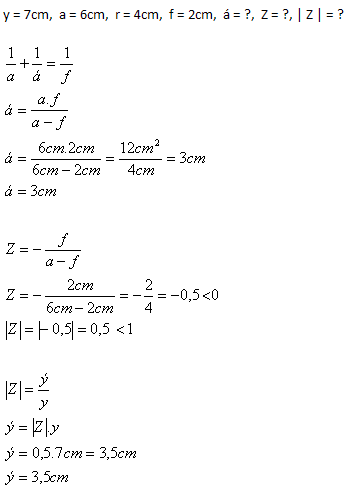
The image is reduced, inverted, real, and 3.5 cm high. It lies 3 cm from the mirror’s vertex.
3.An object 6.5 cm high stands perpendicular to the optical axis of a concave mirror at a distance of 1 cm from the mirror’s vertex. The radius of the mirror is 4 cm. Determine the position and properties of the image.
Solution:
Analysis:
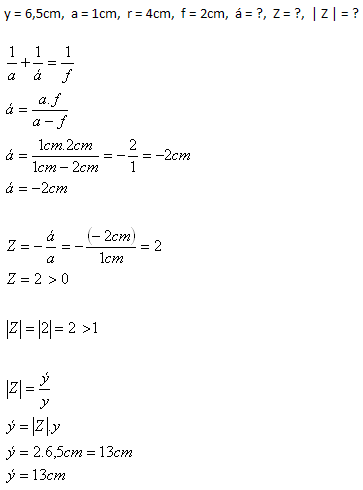
The image is magnified, upright, virtual, and 13 cm high. It is formed 2 cm behind the mirror.
4.A concave mirror with a curvature radius of 1 m produces a virtual image 3 m behind the mirror. At what distance in front of the mirror is the object located? What is the magnification of the image?
Please log in to view the solution.
5.An object is placed at a distance of 60 cm from the vertex of a concave mirror. Determine the focal length of the mirror if the real image of the object (Z < 0), formed on a screen, is magnified 1.5 times.
Please log in to view the solution.
6.Where should an object be placed in front of a concave mirror with a focal length f = 40 cm in order to obtain an inverted image 4 times larger than the object?
Please log in to view the solution.
7.An object is located 1.4 m from a concave mirror, and its image is 0.6 m from the mirror. Determine the focal length of the mirror, its radius of curvature, and the magnification of the image.
Please log in to view the solution.
8.An object stands 60 cm in front of a concave mirror. If the object is moved 10 cm closer to the mirror, the distance of the image from the mirror increases by 80 cm. What is the focal length of the mirror?
Please log in to view the solution.
9. At what distance from a convex mirror (a < 0, f < 0) should a light source be placed so that its image is 60 cm from the mirror? The focal length of the mirror is 90 cm.
Please log in to view the solution.
10. A person is looking at a silvered sphere ( a < 0, f < 0 ) with a radius of 0.3 m, which is at a distance of 0.25 m from him. At what distance from the observer is his image located?
Please log in to view the solution.
11. A light ray falls on a plane mirror. The mirror rotates by an angle α = 1o around an axis lying in the plane of the mirror and perpendicular to the ray. By how much does the light spot shift on a screen that is perpendicular to the reflected ray and 5 m away from the mirror?
Please log in to view the solution.12.Using a plane mirror in which we see the top of a tower, we can determine the height of the tower. How tall is the tower if the observer's eye is at a height of 1.6 m above the ground? The mirror lies on the ground at a distance of 45 m from the tower and 1 m from the observer.
Please log in to view the solution.13. A light ray traveling horizontally falls perpendicularly on a vertical screen. If we insert a plane mirror (tilted relative to the incident ray) into the path of the ray at a distance of 60 cm from the screen, the light spot on the screen shifts by 5.2 cm. What is the angle of incidence of the ray on the mirror?
Please log in to view the solution.14.On the axis of a convex mirror with a focal length of 60 cm, an object is located at a distance of 40 cm. Determine the position and properties of the image.
Please log in to view the solution.15.An automobile with a height of 1 m stands at a distance of 2 m from a convex traffic mirror. What is the focal length of the mirror if the image of the automobile appears 0.18 m high in the mirror?
Please log in to view the solution.16.Calculate the height of the image of a 180 cm tall person in a convex mirror with a focal length of 45 cm. The person is 3 m from the mirror.
Please log in to view the solution.
17.The image of a candle placed in front of a convex mirror with a focal length of 25 cm is reduced to one-fifth. Where is the candle located?
Please log in to view the solution.18.The distances of an object and its image from the vertex of a concave mirror are in the ratio 1 : 4. Determine the radius of curvature of the mirror if the distance of the object from the vertex is 50 cm.
Please log in to view the solution.19.An object 1 cm high stands in front of a spherical mirror at a distance of 10 cm. The mirror forms an upright image 3 cm high. What kind of mirror is it and what image does it produce?
Please log in to view the solution.20.A point light source is placed on the optical axis of a concave spherical mirror at a distance equal to twice the radius of curvature. Where is the image of the source located and what are its properties?
Please log in to view the solution.
