Work and performance in direct current circuit
1.State the basic relations for calculating work and power in a direct current circuit.
Solution:
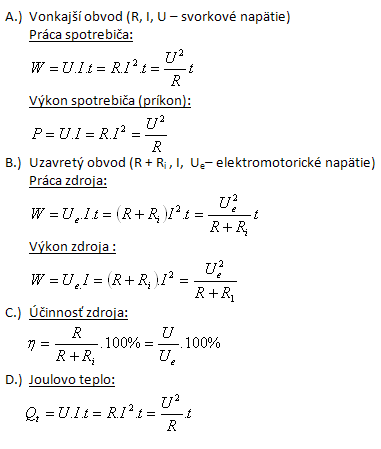
A.) External circuit (R, I, U – terminal voltage)
Work of the consumer (load):
Power of the consumer (input power):
B.) Closed circuit (R + Ri, I, Ue = electromotive voltage)
Work of the source:
Power of the source:
C.) Efficiency of the source:
D.) Joule heat:
2.The powers of two heating elements are P1 = 18W, P2 = 24W at a voltage U = 12V. What power will both elements have when connected to the same voltage 12V if we connect them:
- a) in parallel
- b) in series
Solution:
Analysis:
P1 = 18W, P2 = 24W, U = 12V, R1 = ?, R2 =?, P = ?, P‘ =?
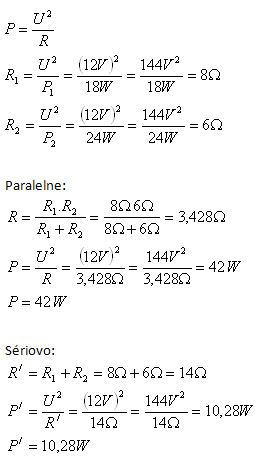
- When connected in parallel the power will be 42W
- When in series 10.28W.
3.From a nichrome wire (ρ = 0.44·10-6 Ω·m) with diameter d = 0.5 mm a heating coil is to be made, in which at a voltage of 120V 1667 kJ of heat would be generated in 1 hour. What length of wire is required?
Solution:
Analysis:
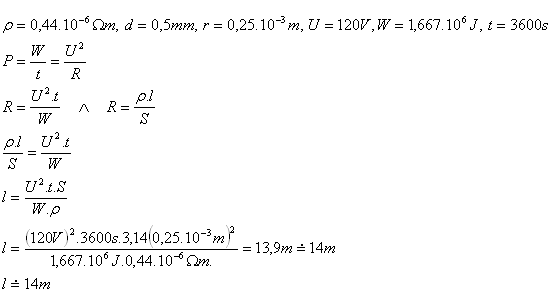
The length of wire required to make the heating coil is 14 m.
4.An electric heating pad connected to the highest heating level has at voltage U = 220V a power P = 15W. What is the resistance of the pad? What current flows through it? How much electrical energy does it consume in 10 hours of operation?
Solution:
Analysis:
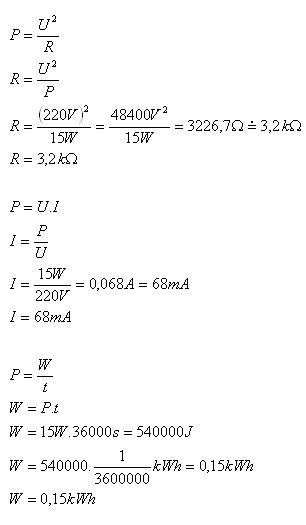
The resistance of the pad is 3.2 kΩ, the current 68 mA and in 10 hours it consumes 0.15 kWh of electrical energy.
5.What ampere fuse should be used to protect an electrical line in which 10 bulbs 100W/220V are connected in parallel at a voltage of 220V.
Solution:
Analysis:
U = 220V, P = 100W, n = 10, I = ?
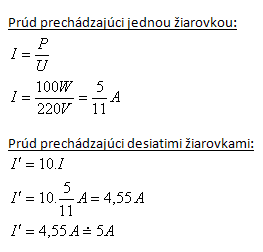
Current passing through one light bulb:
Current passing through ten light bulbs:
A 5A fuse should be connected to the electrical line.
6.To a flat battery with Ue = 4.5V and Ri = 1Ω a bulb with resistance R = 9Ω is connected. Determine the total power of the battery Pz, the useful power in the external circuit (power of the bulb P) and the efficiency of energy transfer from the battery to the bulb.
Solution:
Analysis:
Ue = 4.5V, Ri = 1Ω, R = 9Ω, PZ = ?, η = ?
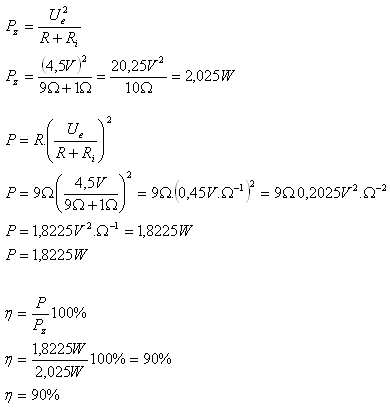
The efficiency of energy transfer from the battery to the bulb is η = 90.
7.What current flows through an electric cooker if 10 liters of water are heated on it from 20°C to 100°C in 30 minutes? The efficiency of the cooker is 75%, the mains voltage is 230V. (c = 4180 J·kg-1·K-1)
Solution:
Analysis:
m = 10 kg, Δt = 80°C = 80 K, U = 230V, τ = 30 min = 1800 s, η = 0.75, c = 4180 J·kg-1·K-1
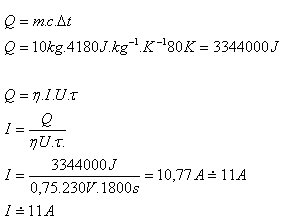
Approximately 11 A flows through the electric cooker.
8.An elevator with mass 1.2 tons rose to a height of 15 m in 0.5 min. The voltage at the terminals of the motor that lifted the elevator is 230V (η = 90%). Determine the current passing through the meter!
Solution:
Analysis:
m = 1200 kg, t = 30 s, h = 15 m, U = 230V, η = 90% = 0.9, I = ?
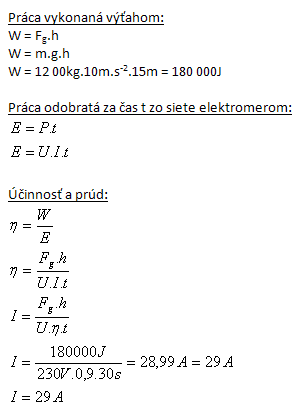
Work done by the elevator:
Energy taken from the mains by the electricity meter during time t:
Efficiency and current:
The meter current is I = 29 A.
9.Three identical flat batteries are connected in a circuit, each with Ue = 4.5V and Ri = 1.5Ω. The external resistance connected to the circuit is R = 10Ω. Determine the electrical power in the external circuit when the batteries are connected
- a.) in series
- b.) in parallel
Solution:
Analysis:
Ue = 4.5V and Ri = 1.5Ω, R = 10Ω, n = 3, P1 = ?, P2 = ?
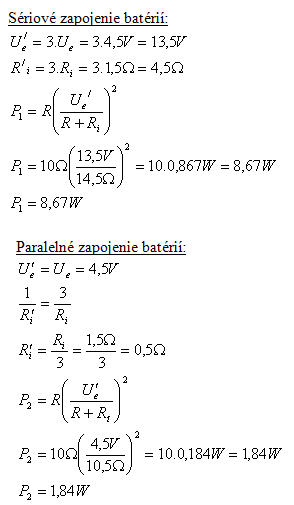
Series connection of batteries:
Parallel connection of batteries:
- For series connection of the batteries P1 = 8.67W
- for parallel P2 = 1.84W.
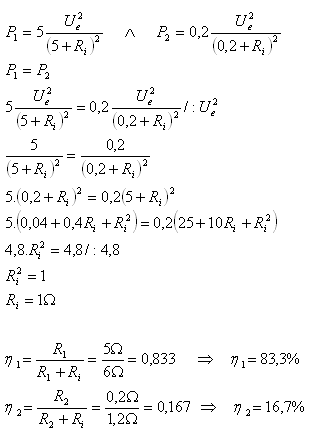
10.When a device with R1 = 5Ω is connected to a given source Ue the power of the device is the same as the power of a device with R2 = 0.2Ω connected to the same source. Determine the internal resistance of the source Ri and for each device also its efficiency.
Solution:
Analysis:
R1 = 5Ω, R2 = 0.2Ω, Ri = ?, η1= ?, η2= ?,
11.A candle for a Christmas tree has a power input P = 8.9 W and resistance R = 20 Ω. How many candles can be connected in series to a voltage of U/ = 220 V?
Solution:
We can connect 16 candles in series on the Christmas tree.
12. In stores, you can buy a cooker for voltage U = 220 V with power inputs P1 = 300 W, P2 = 900 W. What resistances correspond to each power input? In the third cooker, resistors R1 and R2 are connected in parallel.
Solution:
The resistances corresponding to the given power inputs are R1 = 161.33 Ω, R2 = 53.77 Ω, and R3 = 40.33 Ω.
13.Two bulbs, one 25 W and the other 100 W, are connected in series to a 220 V supply. Determine the voltage across each bulb.
Solution:
The voltage across the bulbs is U1 = 44 V and U2 = 176 V.
14.What current flows through a small immersion heater rated 220 V / 500 W? How long does it take to heat 1 kg of water from 100C to 1000C? (Neglect losses.)
Solution:
The current through the small immersion heater is I = 2.27 A. The water heats up in τ = 12.55 minutes.
15.When leaving the house, you forgot to switch off a 100 W bulb. It shone unnecessarily for 24 hours. How much electrical energy did it consume? Determine the mass of water that could be pumped to a height of 10 m using this energy.
Solution:
The bulb unnecessarily consumed W = 8.64×10⁶ J of electrical energy. Using this energy, m = 8.64×10⁴ kg of water can be pumped.
16.A battery with electromotive voltage Ue = 10 V and internal resistance Ri = 1 Ω is connected to a resistor. The electric power in the resistor is P = 9 W. Determine the terminal voltage of the battery.
Solution:
The terminal voltage of the battery is U1 = 9 V, or U2 = 1 V. In the external circuit, the resistor is R1 = 9 Ω, or R2 = 1/9 Ω.
17.An electrical source with Ue = 240 V and Ri = 1 Ω is connected to a load with electrical resistance R = 23 Ω. Calculate:
- a.) power of the load (input power)
- b.) power of the source
- c.) efficiency of the source
Solution:
The load power is P = 2.3 kW, the source power is Pz = 2.4 kW, and the efficiency of the source is η = 96%.
18.Two identical bulbs with equal power P1 = P2 = 60 W are connected to a voltage U = 220 V. The bulbs are:
- a.) connected in series
- b.) connected in parallel. Calculate the Joule heat in both cases if the bulbs were lit for 10 min.
Solution:
19.An iron wire has twice the resistance of a copper wire. In which wire is more heat produced when the wires are connected in parallel to a constant-voltage supply? R(Cu) = R1, R(Fe) = R2
Solution:
Twice as much heat is produced in the copper wire as in the iron wire.
20.An iron wire has twice the resistance of a copper wire. In which wire is more heat produced when the wires are connected in series to a constant-voltage supply? R(Cu) = R1, R(Fe) = R2
Solution:
Half as much heat is produced in the copper wire as in the iron wire.