Pyramid and Cone
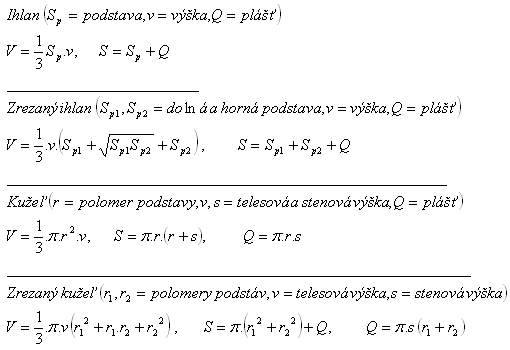
1. Characterize the calculation of volume and surface area for:
- pyramid
- frustum of a pyramid
- cone
- frustum of a cone
Solution:
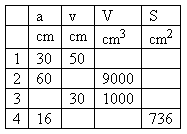
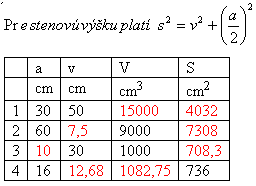
2. A regular square pyramid is given (the base is a square with side a).
Fill in the missing values of the table.
Solution:
3. Above each face of a cube with edge a = 30 cm, a regular square pyramid with height 15 cm is constructed.
Calculate the volume of the solid formed in this way, if the vertices of the pyramids:
a) lie outside the cube
b) lie inside the cube
Solution:
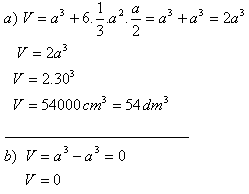
The volume of the solid in the first case is V = 54 dm
3, in the second case it is zero.
4. Calculate the volume of a pyramid whose lateral edge of length 5 cm forms an angle α = 60° with the square base. (Angle α is the angle between the edge and the diagonal of the base.)
Solution:
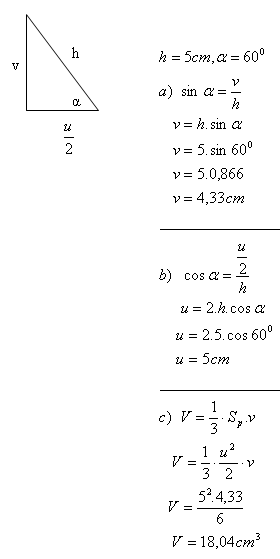
The volume of the pyramid is V = 18.04 cm
3.
5. Determine the mass of a concrete pillar (ρ = 2.2 g.cm-3) in the shape of a regular square frustum of a pyramid, if its square bases have sides a = 45 cm, b = 25 cm, and the height of the pillar is v = 33 cm.
Solution:
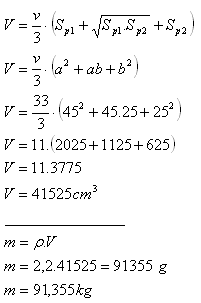
The mass of the concrete pillar is m = 91.355 kg.
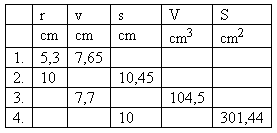
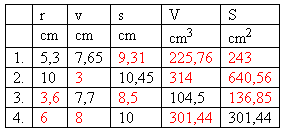
6. A cone with dimensions given in the table is given.
Fill in the table.
Solution:
7. A right triangle with legs a = 3 cm, b = 4 cm rotates around the longer leg.
Calculate the volume and surface area of the cone formed.
Solution:
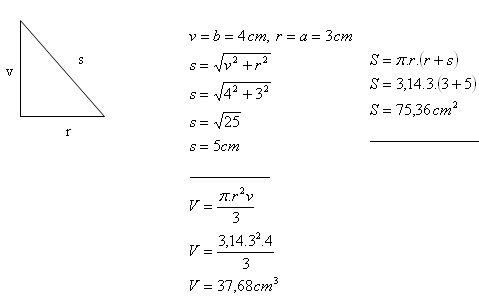
The cone has volume V = 37.68 cm
3 and surface area S = 75.36 cm
2.
8. The surface area of a cone is S = 235.5 cm2. The axial section of the cone is an equilateral triangle.
Calculate the volume of the cone.
Solution:
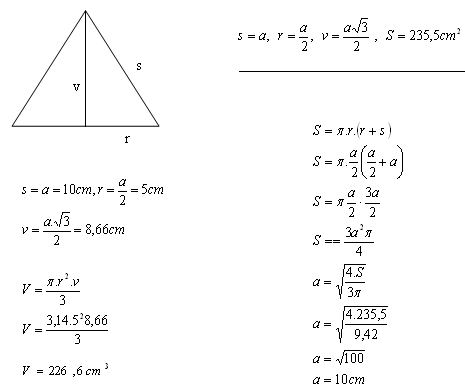
The volume of the cone is 226.6 cm
3.
9. The lateral surface of a cone, developed into the plane, has the shape of a circular sector with central angle α = 150° and area S = 523.4 cm2.
Calculate the dimensions of this cone and its volume.
Solution:
S = 523.4 cm
2 – area of the circular sector with radius R – lateral surface area with radius r
o = R · arcα – circular arc corresponding to the sector
O = 2πr – circumference of the base circle of the cone
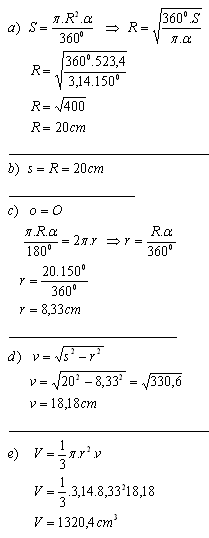
The dimensions of the cone are r = 8.33 cm, s = 20 cm, v = 18.18 cm and volume V = 1320.4 cm
3.
10. The surface area of a frustum of a cone is 7693 cm2, the radii of the bases are 28 cm and 21 cm.
Calculate the height of the cone and its volume.
Solution:
S = 7693 cm
2
R = 28 cm
r = 21 cm
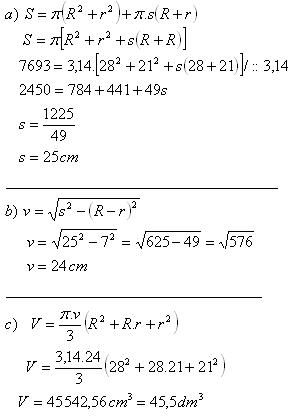
The height of the cone is v = 24 cm, its volume V = 45.5 dm
3.
11. The volume of a frustum of a cone is V = 38 000π cm3. The radius of the lower base is 10 cm larger than the radius of the upper base.
Determine the radii of the bases, if v = 60 cm.
Solution:
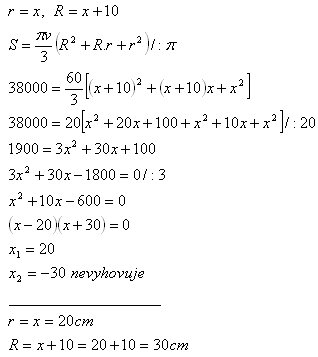
The radii of the bases of the frustum of the cone are R = 30 cm and r = 20 cm.
12. A frustum of a cone with radii x = 15 cm, y = 13 cm and height v = 9 cm was rolled out into a cylinder with radius r = 7.67 cm.
What is the length of this cylinder?
Solution:
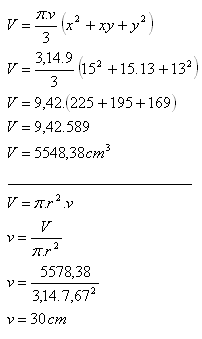
The length / height of the cylinder is 30 cm.