Conductor capacitance
1.Explain the concept of "conductor capacitance"!
Solution:
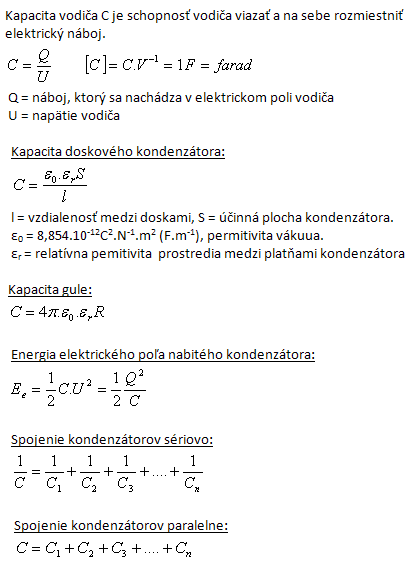
Capacitance of a conductor C is the ability of a conductor to bind and distribute electric charge.
Q= charge located in the electric field of the conductor
U= voltage of the conductor
Capacitance of a parallel-plate capacitor:
l= distance between the plates, S= effective area of the capacitor plates.
, permittivity of vacuum.
εr= relative permittivity of the medium between the capacitor plates.
Capacitance of a sphere:
Energy of the electric field of a charged capacitor:
Capacitors connected in series:
Capacitors connected in parallel:
2.Derive the dimension of the physical unit farad = F. Show that it holds: C2.N-1.m-2 = F.m-1
Solution:
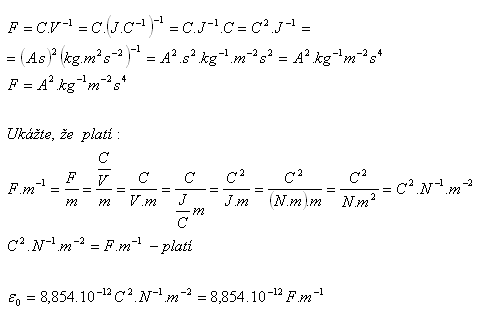
Thus we have shown that 1 F = A2.kg-1.m-2.s4 and that C2.N-1.m-2 = F.m-1
3.Calculate the capacitance of a plate capacitor composed of 11 plates with dimensions 3 cm and 2 cm, if the distance between the plates is 0.2 mm. The dielectric between the plates is mica with εr = 6. There are 10 gaps between the 11 plates.
Solution:
Analysis:
S = a.b = 3cm·2cm = 6 cm2 = 6·10-4 m2, l = 2·10-4 m, εr = 6, ε0 = 8,854·10-12 C2.N-1.m2
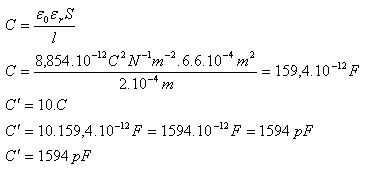
The capacitance of the capacitor is C' = 1594 pF.
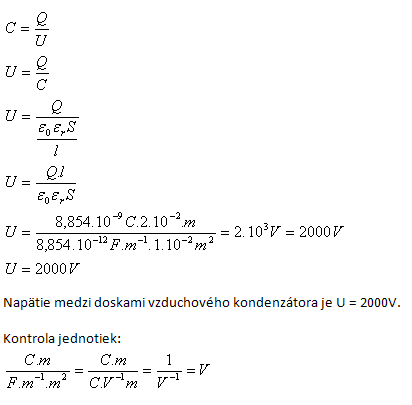
4.What is the voltage between the plates of an air capacitor with two square plates of side 10 cm, separated by 2 cm, if its charge is 8,854·10–3 μC?
Solution:
Analysis:
S = a2 = (10 cm)2 = 100 cm2 = 10-2 m2, l = 2·10–2 m, Q = 8,854·10–9 C, ε0 = 8,854·10–12 F·m-1
5.What is the capacitance of our Earth?
Solution:
Analysis:
R = 6378 km = 6.378·106 m, ε0 = 8,854·10-12 F·m-1, εr = 1
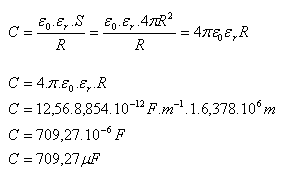
The Earth's capacitance is C = 709.27 μF
6.To what potential will a conductor with a capacitance of 20 picofarads be charged by a charge of 1 microcoulomb?
Solution:
The conductor is charged to a potential of 50 000 V.
7. Determine the relative permittivity of the dielectric in a parallel-plate capacitor whose plates with an area of 1000 cm2 are separated by 0.1 mm and the capacitor is charged by a charge of 17.7·10-6C to 100 V.
Solution:
The relative permittivity of the dielectric is 20.
8. Capacitors with capacitances 6·10-6F and 4·10-6F are connected in series, and in parallel with them a capacitor with capacitance 2·10-6F is connected. What is their resulting capacitance?
Solution:
The resulting capacitance of the capacitors is 4.4·10-6F.
9.Two capacitors of the same capacitance are connected a) in series b) in parallel. The difference between the resulting capacitances of both connections is 3·10-6F. Determine the capacitance of each capacitor.
Solution:
Each capacitor has a capacitance of 2·10–6F.
10. What energy will be stored in a capacitor with plates of area 0.3 m2 and plate separation 1 mm, if we charge it to a voltage of 1000 V? The relative permittivity is 20.
Solution:
The capacitor stores an energy of 26.6 mJ.
11. Two capacitors with capacitances 12·10–6F and 24·10–6F are connected in series to a DC voltage source of 30 V. Find:
- a.) the resulting capacitance
- b.) the charges on the plates of the capacitors
- c.) the ratio of the voltages across the individual capacitors.
Solution:
12. The plates of a capacitor are 5 mm apart and have an area of 2 m2. The plates are in vacuum. Calculate:
- a.) the charge on each plate
- b.) the surface charge density. The voltage across the capacitor is 10 000 V.
Solution:
The charge on each plate is 35.4·10–6C. The surface charge density is 17.7·10–6C·m–2.
13. Capacitors with capacitances C1 = 2·10-6F and C2 = 3·10-6F are connected in parallel. On the capacitor with capacitance C1 there is a charge Q1 = 6·10-6C. What is the voltage and what is the charge on the second capacitor?
Solution:
The voltages across the capacitors are equal U1 = U2 = 3 V.
The charge on the second capacitor is Q2 = 9·10–6C.
14. Three capacitors with capacitances C1 = 2·10-6F, C2 = 3·10-6F, C3 = 6·10-6F are connected in series. What is the resulting capacitance of this connection? What will be the voltage across each capacitor if the whole battery is connected to a voltage of 200 V?
Solution:
The resulting capacitance of the connection is C = 1·10–6F.
The voltages across the individual capacitors are U1 = 100 V, U2 = 66.6 V, U3 = 33.3 V.
15.How will a) the capacitance of the capacitor b) the electric field intensity change if we insert paper between the plates of the capacitor, completely filling the space between them?
Solution:
The capacitance of the capacitor increases 5-fold.
The electric field intensity decreases 5-fold.
16. The distance between the plates of a parallel-plate capacitor is 8.854 mm, the surface charge density on the plates is 10 nC·m–2. There is air between the plates. What is the voltage between the plates?
Solution:
The voltage between the plates of the capacitor is 10 V.
17.The capacitance of the Earth is 709.26·10-6F. The voltage between a nearby cloud and the Earth reached a value of 109V at the moment of the lightning flash. How much electrical energy was released during the lightning?
Solution:
During the lightning, 354 TJ of electrical energy is released.
18.A Leyden jar with radius 5 cm and height 20 cm has a glass wall thickness of 3 mm. The relative permittivity of the glass is 6. Calculate:
- a.) the capacitance of the jar
- b.) the work required to charge the jar to 30 000 V
Solution:
The capacitance of the jar is 1.25·10–9F. The work needed to charge the jar is 0.5625 J.
19. Determine the resulting capacitance of the capacitors (diagram), if the following holds:
Solution:
The resulting capacitance of the capacitors is 3.53 pF.
20.Calculate the resulting capacitance of the capacitors connected as in the diagram.
Solution:
The resulting capacitance of the capacitors is 650 pF.